

Your Packaging Meets the Standard. Does Your Warehouse?
Food packaging manufacturers operate in one of the most tightly regulated segments of the supply chain. Every material that touches food, from flexible films and trays to cartons and closures, must meet strict safety, traceability, and hygiene requirements before it reaches a food producer’s line.
Most packaging manufacturers know this. They invest in clean production environments, certified raw materials, and audited quality systems. But there is a gap that many overlook: what happens to that product between the factory and the customer?
If your finished packaging materials are stored in a warehouse that lacks the right certification, your compliance chain has a weak link. And for food packaging, that weak link can cost you a contract.
What BRCGS Storage and Distribution Certification Actually Covers
The BRCGS (Brand Reputation Compliance Global Standards) Storage and Distribution standard is specifically designed for logistics operations handling food, packaging, and consumer products. It covers everything from pest control and temperature management to stock rotation, traceability, and contamination prevention.
For food packaging manufacturers, the relevant requirements include documented goods-in procedures, segregation of product types, controlled storage conditions, full lot traceability from receipt to dispatch, and regular internal and third-party audits.
The standard uses a grading system. Grade AA is the highest rating, awarded to sites that demonstrate full compliance with zero critical non-conformities at an unannounced audit. It signals to your customers, and their auditors, that the warehouse operation meets the same rigour as the production facility.
Why This Matters More in 2026
Two forces are pushing this up the agenda for packaging manufacturers.
First, retailer and food producer audits are tightening. Major food brands and supermarket groups increasingly audit not just their direct suppliers but the entire upstream chain, including the logistics providers handling packaging materials. If your 3PL cannot produce a current BRCGS certificate, you may find yourself explaining a gap in your next customer audit.
Second, Interpack 2026 (Düsseldorf, 7-13 May) brings together over 2,700 exhibitors from more than 60 countries, many of them food packaging manufacturers looking to grow their European customer base. For companies exhibiting at Interpack, winning new food industry contracts often depends on proving end-to-end compliance. Having a BRCGS-certified logistics partner in your supply chain is not a bonus; it is a qualification criterion.
What to Look for in a 3PL Partner
Not every warehouse with a BRC certificate offers the same depth of service. Here is what food packaging manufacturers should be asking:
What grade does the site hold? Grade AA at an unannounced audit is the benchmark. Anything less may not satisfy your end customer’s audit requirements.
Is customs clearance handled in-house? If your packaging materials are imported into the EU, bonded warehousing with integrated customs processing reduces handling steps and the risk of compliance errors. A separate customs broker adds a coordination layer that most food audits will question.
Can the warehouse handle multiple product types under segregation? Food-contact packaging materials need to be stored separately from non-food products, chemicals, or goods with strong odours. The warehouse must demonstrate documented segregation procedures.
Does the operator control its own transport? Product integrity does not stop at the warehouse door. If the 3PL subcontracts haulage to spot-market carriers, your traceability chain weakens on every outbound load.
How Middlegate Handles Food Packaging Logistics
Middlegate holds BRCGS Storage and Distribution certification at Grade AA across its Zeebrugge warehouse operation. The site also carries ISO 9001:2015 certification, providing a dual layer of quality assurance.
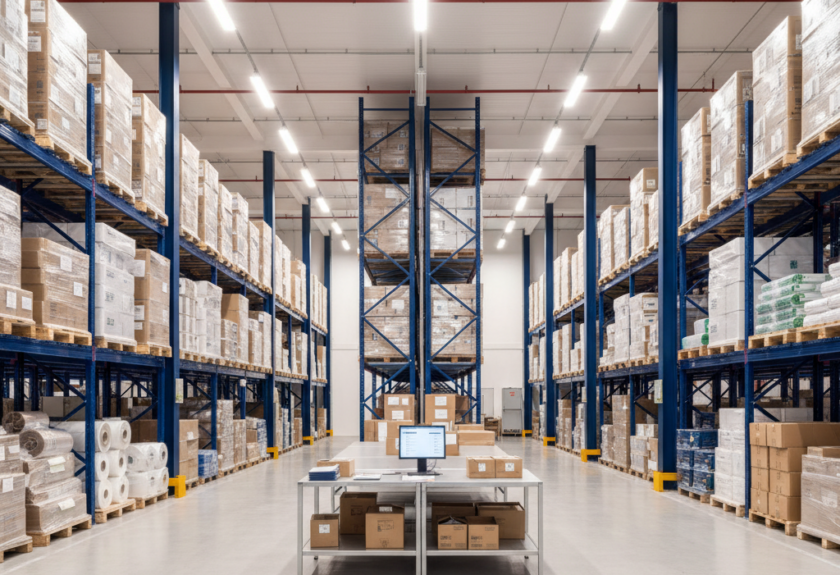
The operation is purpose-built for the kind of product that food packaging manufacturers produce: materials that require clean, dry, controlled storage with full lot traceability and documented handling procedures. Every pallet is tracked from receiving through to dispatch, with barcode-verified put-away and pick processes.
Because Middlegate operates bonded and free-circulation warehousing under one roof, imported packaging materials can be stored under customs suspension until released for delivery. The in-house customs team processes declarations against live warehouse inventory, so there is no gap between what the system shows and what is physically on the rack.
Transport runs on Middlegate’s own fleet: 120+ tractors and 220+ trailers, providing full control over outbound deliveries across the UK, Benelux, France, and Germany. The Zeebrugge site sits directly in the Port of Antwerp-Bruges corridor, giving packaging manufacturers importing raw materials or exporting finished goods a short, controlled link between port and warehouse.
For Interpack Exhibitors: Your European Logistics Base
If you are exhibiting at Interpack 2026 and looking to establish or strengthen your European distribution, the logistics partner you choose will directly affect your ability to win and retain food industry contracts.
Middlegate’s Zeebrugge operation offers food packaging manufacturers a single point of contact for BRC AA-certified warehousing, bonded storage, customs clearance, and transport, all managed by one team, under one roof, with one quality system.
That is not a pitch. It is a structure that passes audits.
Need logistics support?
Get a warehousing, transport, or fulfilment quote from Middlegate Europe.
Request A Quote

