

What happened
Brent crude moved from $73 per barrel on 27 February to $119 by mid-March. A 63% increase in three weeks. The trigger: sustained disruption around the Strait of Hormuz, through which 20% of global oil traffic passes.
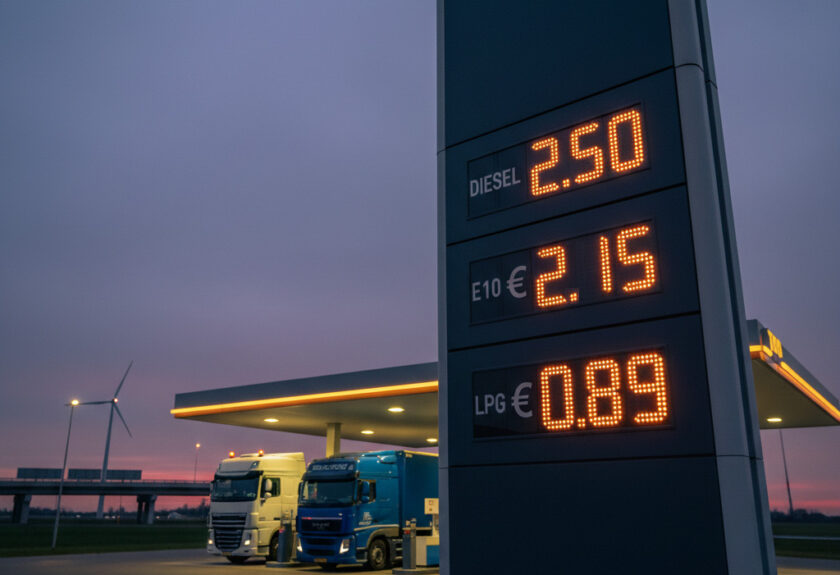
At the pump, Western Europe felt it immediately. Diesel in the Netherlands hit €2.50 per litre — the highest in over two years. Belgium’s price cap mechanism absorbed part of the shock, holding back roughly 7 cents per litre through its correction factor. But diesel still reached record levels. In Germany, diesel climbed 17%. AdBlue followed.
Nine European countries now have diesel above €2 per litre.
What it does to transport costs
Fuel is the single largest variable in road freight. When diesel jumps 25% in a month, every shipment gets repriced.
For companies using broker-led logistics, that repricing happens fast and without cushion. The broker calls the spot market. The subcontractor quotes whatever covers their exposure that week — plus margin. The client pays the stack.
Multiply that across weekly EU–UK shipments and the cost exposure compounds quickly.
Why fleet ownership matters now
Middlegate Europe runs 120+ tractors and 220+ trailers. Own metal. Own drivers. Own routing decisions.
That is not a marketing line. It is a cost structure. When we control the fleet, we control fuel purchasing, load consolidation, empty-kilometre reduction, and route efficiency. We do not renegotiate with a third party every time Brent moves five dollars.
The result: more predictable transport pricing for our clients, even when the market is anything but predictable.
How that plays out in practice
Consolidated flows, not reactive runs. Our warehouses in Zeebrugge, Liège, and Hull sit on the EU–UK corridor. Goods move in planned, consolidated loads — not single-shipment spot bookings. Fewer legs. Higher utilisation. Lower per-unit fuel cost.
Transparent fuel adjustments. When surcharges are necessary, they are based on actual consumption data from our own fleet. Not opaque index references. Not broker markups layered on top of carrier markups.
One operator, fewer surcharge layers. Warehousing, transport, customs clearance, and fulfilment under one roof. Every intermediary you remove is a surcharge layer that disappears.
The wider picture
This fuel spike is not a blip. Analysts do not expect Hormuz disruption to resolve quickly. The pressure on European diesel and transport costs is structural, not cyclical.
For businesses running freight through the Benelux — particularly those managing bonded flows between the EU and UK — the question is whether your logistics partner absorbs volatility or passes it through.
Middlegate Europe operates over 42,000 square metres of warehouse capacity, a fleet built for cross-Channel and Benelux distribution, and an in-house customs team. We own the infrastructure. That is what keeps your costs stable when the market does not cooperate.
Need logistics support?
Get a warehousing, transport, or fulfilment quote from Middlegate Europe.
Request A Quote

